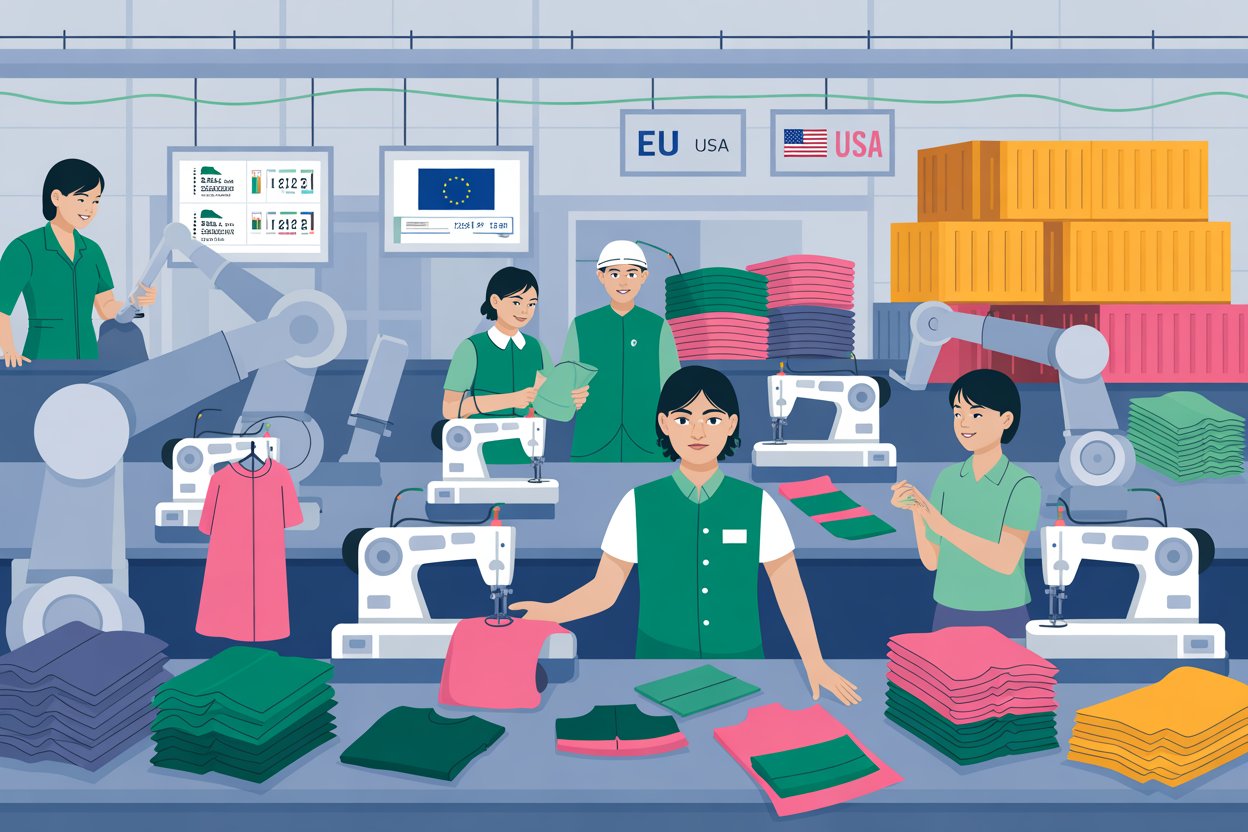


Bangladesh is the world’s second-largest apparel exporter, trailing only China. In the 2024/25 fiscal year, the country’s garment exports reached US$39.35 billion, representing roughly 6.9% of the global apparel market, which was valued at US$557.5 billion. While this confirms Bangladesh’s strength in the global market, the industry’s ambitious goal of achieving US$100 billion in exports by 2029/30 faces significant hurdles.
Modest Growth So Far
Between 2018/19 and 2024/25, the apparel sector’s annual growth averaged just 2–3%, slowed by external shocks such as the COVID-19 pandemic and the war in Ukraine, as well as domestic challenges including political unrest, currency depreciation, high inflation, and infrastructure inefficiencies.
While 2024–25 showed improvement, with exports rising about 8.8% over the previous year, the pace is far from what is needed to reach the US$100 billion mark in five years.
Structural Challenges
One of the major limitations is Bangladesh’s dependence on imported raw materials. Nearly all cotton and a large portion of woven fabric are imported, increasing production costs and lead times. With the taka depreciating, import bills are heavier, squeezing factory margins in a price-sensitive global market.
Another challenge is the overconcentration of export markets. More than 80% of exports go to the EU and USA, making Bangladesh vulnerable to tariffs and trade restrictions. Following the country’s graduation from least developed country (LDC) status in 2026, preferential access to some markets will be reduced, and factories may need to comply with stricter rules of origin.
Opportunities in Man-Made Fiber (MMF) Garments
Global apparel demand is shifting rapidly toward man-made fiber (MMF) and blended garments. By 2030, MMF-based products are expected to constitute about 60–70% of global garment trade value, while cotton’s share will fall to roughly 25%. Bangladesh has started to adapt: MMF exports currently make up about 29.2% of total apparel exports, up from 23% three years ago.
Expanding production in MMF and value-added garments offers the biggest opportunity for Bangladesh to close the gap toward US$100 billion. Higher-value products like sportswear, activewear, and technical textiles can bring greater margins than basic cotton T-shirts.
Strengths and Recent Positive Trends
Bangladesh has several advantages that could support rapid growth:
- Investment-friendly environment: Liberal foreign investment policies, tax incentives, and export processing zones attract global brands.
- Sustainability leadership: Bangladesh boasts the largest number of LEED-certified green garment factories in the world.
- Strong buyer confidence: Major brands such as Gap, H&M, Levi’s, and Zara continue sourcing from Bangladesh, particularly after safety and compliance improvements since 2013.
- Market recovery: Early 2025 exports to the USA jumped 26.6% year-on-year in Q1, indicating robust demand.
Forecast: How Close Can Bangladesh Get?
Using recent export data and growth scenarios, Bangladesh’s apparel exports could develop as follows by 2030:
| Year | Baseline Growth (6%) | Aggressive Growth (10%) | Ambitious Target Growth (14%) |
|---|---|---|---|
| 2025 | 39.35 | 39.35 | 39.35 |
| 2026 | 41.71 | 43.29 | 44.86 |
| 2027 | 44.21 | 47.61 | 51.14 |
| 2028 | 46.87 | 52.37 | 58.30 |
| 2029 | 49.68 | 57.61 | 66.46 |
| 2030 | 52.66 | 63.37 | 75.77 |
Key takeaways:
- Baseline growth (6%) leaves exports just over US$52 billion, far from the target.
- Aggressive growth (10%) could reach around US$63 billion, still short of US$100 billion.
- Even an ambitious 14% annual growth reaches US$75.8 billion, meaning the US$100 billion target would require growth above 17–18% per year, demanding rapid sectoral transformation.
Steps Needed to Achieve the Goal
Experts suggest that reaching US$100 billion requires:
- Backward-linkage investment: Strengthening spinning, weaving, and dyeing capacity for both cotton and MMF.
- Market diversification: Expanding exports to Japan, South Korea, Australia, Latin America, and the Middle East.
- Technology and skills upgrades: Using automation, digital sampling, 3D design, and AI-driven productivity tools.
- Infrastructure improvements: Efficient ports, energy stability, and predictable policies.
- Value-added product focus: Sportswear, activewear, technical textiles, and MMF lines.
Bangladesh has the workforce, manufacturing scale, and global buyer confidence to grow substantially. However, achieving the US$100 billion target by 2029/30 is extremely challenging. It would require unprecedented growth and simultaneous reforms in raw material capacity, market diversification, and technology adoption.
If the sector moves strategically and decisively, Bangladesh could not only increase exports significantly but also transform into a high-value, technology-enabled apparel powerhouse, positioning itself for long-term competitiveness in the global garment market.