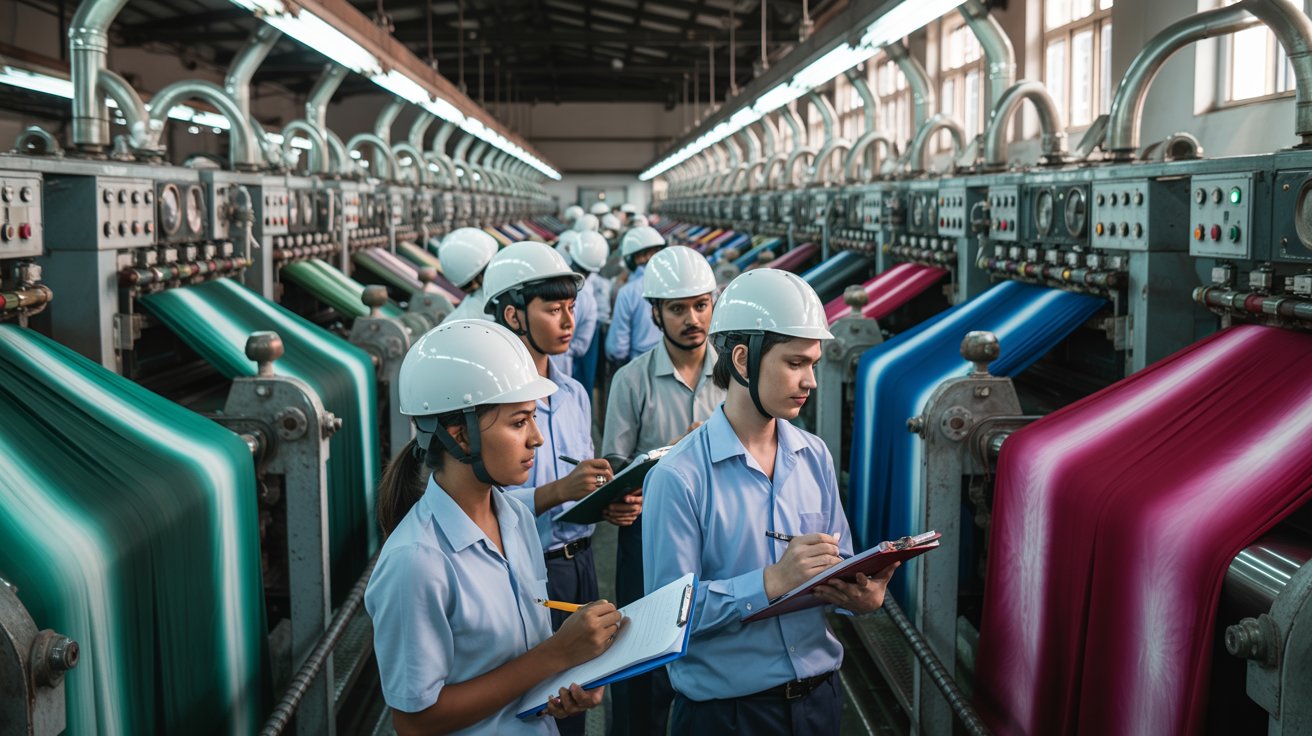


Bangladesh’s textile industry continues to be a training ground for future engineers and technologists. One of the most hands-on experiences for interns is in the oven dyeing section, where fabric undergoes transformation from raw material to finished product. A structured approach to learning is essential, and here’s a detailed roadmap for interns eager to make the most of their time on the floor.
1. Floor Orientation and Layout
The first step for any intern is to familiarize themselves with the oven dyeing floor. This involves understanding the design drawings and floor layout, including:
- Floor measurements and machine-to-machine distances.
- Machine heights and emergency evacuation systems.
- Island placements and workflow mapping.
The goal is to mentally map the floor layout, similar to how military strategists plan a battlefield. This process helps interns quickly recognize machine types, positions, and operations during later stages.
2. Machine Specifications
Once familiar with the floor layout, interns should focus on each machine’s technical details:
- Brand, model, origin, and production capacity.
- Power consumption, speed (RPM), and functionality.
Learning these specifications allows interns to understand machine performance and limits, while memorizing key details will make future operations and troubleshooting easier.
3. Raw Material and Yarn Knowledge
A strong understanding of yarn types and usage is essential:
- Visit the yarn store to observe different types such as cotton carded, combed, slub, mélange, lycra, polyester, CVC, and PC blends.
- Learn their compositions, counts, origin, and typical applications.
- Understand yarn pricing and the quantities used in production.
This knowledge forms the foundation for production planning, cost estimation, and quality assessment.
4. Grey Fabric Handling and Pretreatment
Before dyeing, fabric undergoes pretreatment:
- Observe four-point grey inspection, mending, and selvage cutting.
- Note fabric storage, handling, and delivery to sizing machines.
- Study sizing, bleaching, and mercerizing operations. Learn chemical recipes, dosing, and batch processing.
- Check offline fabric quality including whiteness, absorbency, and pH.
Spending 2–3 days in this section provides insight into the preparatory steps that directly affect dyeing quality.
5. Dyeing Processes
Interns should spend 5–7 days in the textile lab and dyeing floor:
- Learn physical testing and chemical color matching. Understand stock solutions, rapid padding, and spectrophotometer usage.
- Observe cold pad batch and jigger dyeing machines. Learn color recipes, trichromatic combinations, and production workflows.
- Collaborate with production officers to understand color calculation and recipe adjustments.
- Study troubleshooting for deep or light shades and variations across brands or lots.
This exposure helps interns understand the science behind consistent and accurate fabric coloration.
6. Finishing Section
Finishing processes give fabrics their final appearance and feel:
- Observe yarn-dyed fabric processes, brushing, sueding, and oven pitch adjustment.
- Record machine parameters such as temperature, speed, and RPM.
- Learn finishing techniques, chemical applications, consumption calculations, and costing.
- Study stenter, compactor, and special finishing machinery operations.
Interns will also learn to monitor GSM, shrinkage, bowing, twisting, and other critical quality factors.
7. Quality Inspection
A key part of learning is understanding quality control:
- Follow inspectors to observe production losses, fabric faults, and four-point inspections.
- Collect sample faults and document them.
- Track online and offline inspection processes, fabric GSM boards, and production continuity.
Observing quality officers provides insight into production standards and real-time problem solving.
8. Utility and Maintenance
Support systems in dyeing plants are crucial:
- Visit ETP, water treatment, boilers, compressors, and workshops.
- Study the caustic recovery plant process.
- Consult mechanical and electrical foremen about machine parts, common faults, RPM settings, and troubleshooting.
Understanding maintenance ensures interns can appreciate the interconnections between production efficiency and utility systems.
9. Production Planning and Reporting
Interns should also learn about production management:
- Observe daily, monthly, and yearly reports.
- Understand machine cleaning, floor management, and neat dyeing floor standards.
- Track shrinkage, line marks, and issue resolution.
- Learn order booking, machine selection, and R&D sample development processes.
This knowledge prepares interns for future roles in production planning and management.
10. Tips for Effective Learning
- Dedicate 12 hours per day for 4–5 days or up to a week for observation and practice.
- Take detailed notes, photographs (where allowed), and maintain a daily diary.
- Ask questions and engage with senior guides, supervisors, and faculty mentors.
- Understand that mastering these skills takes years; early exposure builds foundational knowledge.
An internship in oven dyeing is an immersive learning experience. By systematically following this checklist, interns can gain a solid understanding of floor operations, machine technology, fabric processing, dyeing chemistry, finishing, quality inspection, and production management. Regular observation, detailed note-taking, and proactive engagement will ensure interns not only learn but also contribute effectively to the factory environment.